Learn your lines.
Keep them in your head.
A few ways to make the time between rehearsals more useful.

You read the scene again. It feels familiar. Then you put the script down, hear your cue, and the next line is gone. If that sounds familiar, try changing what you do during those twenty minutes of practice.
Read the scene before you learn the lines.
Work out what your character wants, who they’re speaking to and what changes during the conversation. Put the scene into your own words once, then return to the exact text. A sentence is easier to work with when you know why you’re saying it.
Take one exchange at a time.
Choose a short exchange that makes sense on its own. Learn that, then add the next one. Include the other character’s cue every time. If you only practise your own speeches, you’re leaving out the words that tell you when to begin.
Close the script sooner.
Read a few lines, cover them and try saying them aloud. If you get stuck, look, check the wording, then try again from the cue. Give yourself a chance to remember before reaching for the page.
This is called retrieval practice: bringing something to mind instead of repeatedly reading it. Research supports it as a learning technique. More on retrieval practice.
Come back to it tomorrow.
Try a short session today, another tomorrow and a further check a few days later. Start each return by seeing what you remember. Research supports spreading practice over time for longer-term retention; the exact schedule can fit around your rehearsals. Read the research review.
Practise the bit you keep missing.
When the same line trips you up, mark it. Run its cue and your reply a few times, then put it back into the scene. Starting at page one every time can leave you spending most of your session on the opening you already know.
Listen to your partner, too.
Rehearse with someone else when you can. Listen to the whole cue and respond to what is being said. If you use a recording, leave room to say your own line before you check it. Keep practising with people as well: their timing and delivery will change.
Where Stageclue saves time.
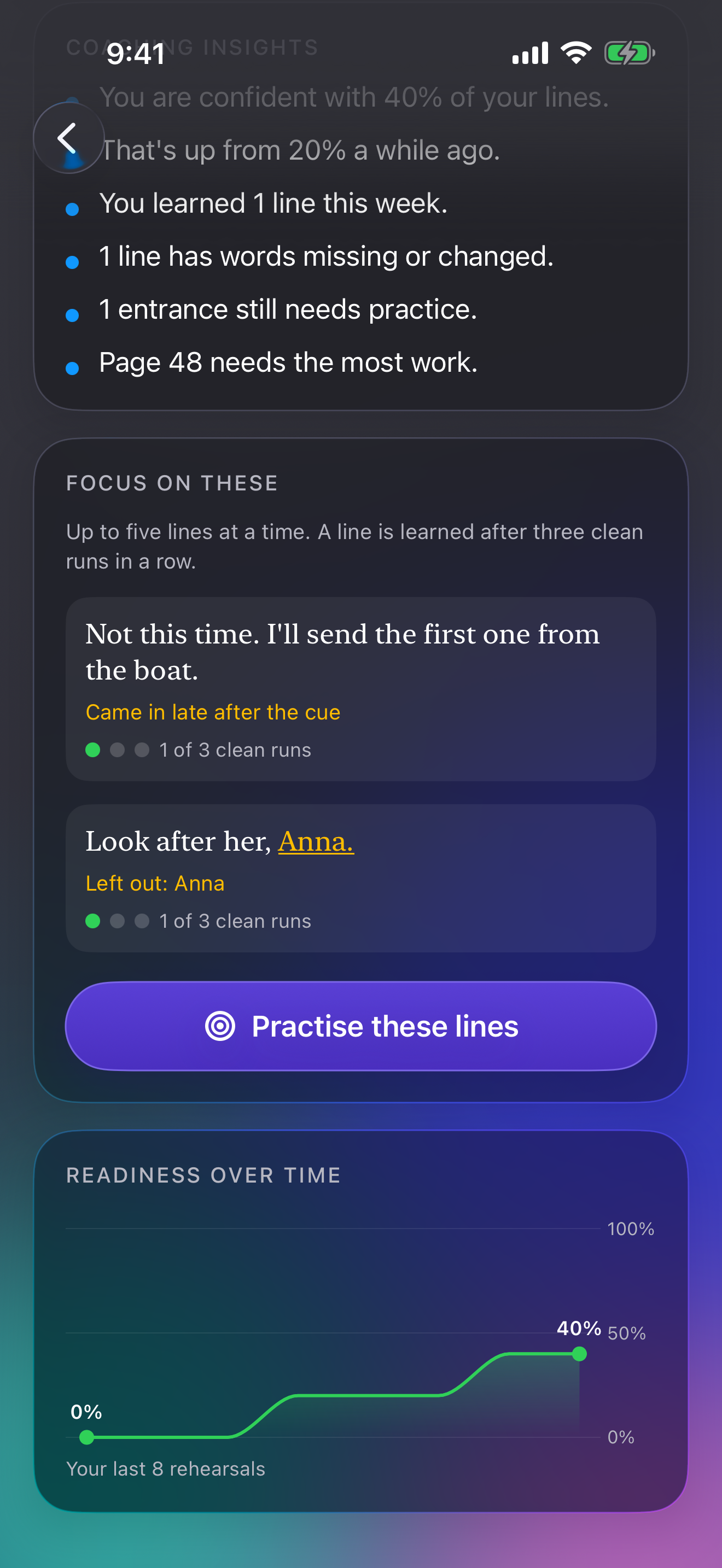
These are the things Stageclue is built to help with. Each actor can record their part and share it, so you can practise with your scene partners’ voices when you’re on your own. You don’t have to record every character yourself or arrange a meeting for each run-through.
The app plays the other characters and waits for your line. Rehearsal feedback can show hesitation and words that differ from the script, and you can work on up to five lines that need attention. That gives a short session a clear job.
When the script changes, you can share the update with the cast. Each person accepts the changes, and only the changed lines need recording again. That means less time passing around revised copies and rebuilding recordings.
The advantage of real voices is that you’re practising with the people you’ll hear at rehearsal. For me, that feels closer to working with the cast. How quickly you learn still depends on the text and how you practise; Stageclue helps reduce the setup and repetition around that work.
Word checking requires offline speech recognition for the script’s language and Android 13 or later on Android.
Try this with one scene tonight.
Pick a short exchange. Read it for meaning, then hear the cue and say your reply without looking. Check the words. Spend the rest of your session on the lines you missed, and finish by running the exchange once more. Tomorrow, try it before opening the script.